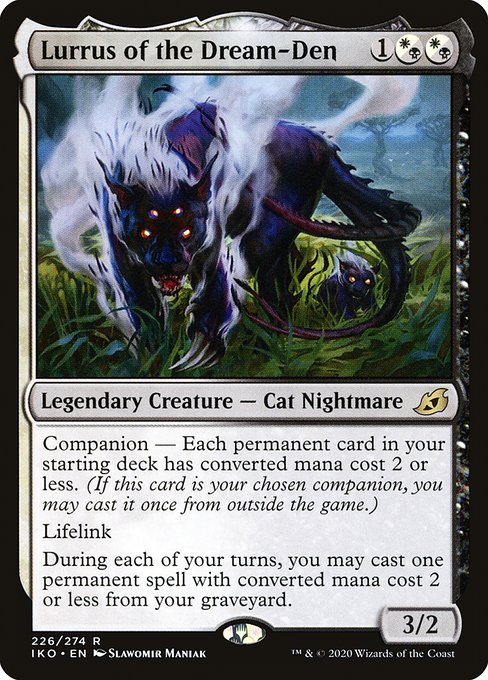
Lurrus of the Dream-Den
Companion — Each permanent card in your starting deck has mana value 2 or less. (If this card is your chosen companion, you may put it into your hand from outside the game for {3} as a sorcery.) Lifelink Once during each of your turns, you may cast a permanent spell with mana value 2 or less from your graveyard.
Rulings (23)
Apr 17, 2020 · The companion ability has no effect if the card is in your starting deck and creates no restriction on putting a card with a companion ability into your starting deck. For example, Zirda may be in your starting deck even if your other permanent cards don't all have activated abilities.
Apr 17, 2020 · Lurrus doesn't care about instant and sorcery cards in your starting deck. They may have any mana value.
Apr 17, 2020 · You must follow the normal timing permissions and restrictions of the spell you cast from your graveyard.
Apr 17, 2020 · If more than one player wishes to reveal a companion, the starting player does so first, and players proceed in turn order. Once a player has chosen not to reveal a companion, that player can't change their mind.
Apr 17, 2020 · For spells with {X} in their mana costs, use the value chosen for X to determine the spell's mana value. For example, if a permanent spell costs {X}{W}, you could cast it with X as 1 but not as 2.
Apr 17, 2020 · If you cast a spell from your graveyard using another permission, Lurrus's effect doesn't apply. You can cast another permanent spell from your graveyard.
Apr 17, 2020 · Your companion begins the game outside the game. In tournament play, this means your sideboard. In casual play, it's simply a card you own that's not in your starting deck.
Apr 17, 2020 · If you reveal a companion outside the game, for as long as it remains there, you may pay {3} any time you could cast a sorcery (that is, you have priority during your main phase and the stack is empty). Once you do, you put it into your hand and behaves like any other card you've brought into the game. For example, if it's discard, countered, or destroyed, it's put into your graveyard, remaining in the game. This is a change from previous rules.
Apr 17, 2020 · Once you begin to cast the spell, losing control of Lurrus won't affect the spell. You can finish casting it as normal.
Apr 17, 2020 · If you cast one permanent spell from your graveyard and then have a new Lurrus come under your control in the same turn, you may cast another permanent spell from your graveyard that turn.
Apr 17, 2020 · The companion's other abilities apply only if the creature is on the battlefield. They have no effect while the companion is outside the game.
Apr 17, 2020 · Lurrus doesn't let you play lands from your graveyard.
Apr 17, 2020 · You must pay the costs to cast that spell. If it has an alternative cost, such as a mutate cost, you may cast it for that cost instead.
Apr 17, 2020 · Paying {3} to put your companion into your hand is a special action. It doesn't use the stack and players can't respond to it. Once you take this action, you may cast that card if it's legal to do so before any other player can take actions.
Apr 17, 2020 · The requirements of the companion ability apply only to your starting deck. They do not apply to your sideboard.
Apr 17, 2020 · If a card in a player's deck has {X} in its mana cost, X is considered to be 0.
Apr 17, 2020 · You may have one companion in the Commander variant. Your deck, including your commander, must meet its companion requirement. Your companion is not one of your one hundred cards.
Apr 17, 2020 · Before shuffling your deck to become your library, you may reveal one card from outside the game to be your companion if your starting deck meets the requirements of the companion ability. You can't reveal more than one. It remains revealed outside the game as the game begins.
Apr 17, 2020 · If a permanent card is put into your graveyard during your main phase and the stack is empty, you have a chance to cast it before any player may attempt to remove that card from your graveyard.
Jun 1, 2020 · Once you put your companion into your hand, it behaves like any other card you’ve brought into the game. For example, if it’s countered or destroyed, it’s put into your graveyard, remaining in the game.
Jun 1, 2020 · Paying {3} to put your companion into your hand is a special action. It doesn't use the stack and players can't respond to it. Once you take this action, you may cast that card if it's legal to do so before any other player can take actions.
Jun 1, 2020 · If you reveal a companion outside the game, for as long as it remains there, you may pay {3} any time you could cast a sorcery (that is, you have priority during your main phase and the stack is empty). Once you do, you put it into your hand and behaves like any other card you've brought into the game. For example, if it's discarded, countered, or destroyed, it's put into your graveyard, remaining in the game. This is a change from previous rules.
Jun 1, 2020 · Wizards of the Coast has issued functional errata for the Companion mechanic. Instead of casting companions from outside the game: Once per game, any time you could cast a sorcery (during your main phase when the stack is empty), you can pay {3} to put your companion from your sideboard into your hand. This is a special action, not an activated ability. It happens immediately and can’t be responded to. It can’t be countered or stopped by cards like Phyrexian Revoker. For more information please see https://magic.wizards.com/en/articles/archive/news/june-1-2020-banned-and-restricted-announcement
Where it’s played now
Inclusion by archetype · Vintage
| Archetype | Format | Inclusion | Copies | Decks (n) |
|---|---|---|---|---|
| UB Lurrus Control | Vintage | 100% | 1× | 37 |
| Lurrus Breach | Vintage | 100% | 1× | 34 |
| Lurrus PO | Vintage | 100% | 1× | 25 |
| Esper Lurrus Control | Vintage | 100% | 1× | 19 |
| Lurrus Doomsday | Vintage | 100% | 1× | 19 |
| Lurrus DRS | Vintage | 100% | 1× | 3 |
| Lurrus Vault Key | Vintage | 100% | 1× | 2 |
| Other Lurrus | Vintage | 69.7% | 1× | 33 |